Be E-Bike Safe
E-bikes are growing in popularity. They provide many benefits including teen independence and traffic and pollution reduction. But they must be legal.
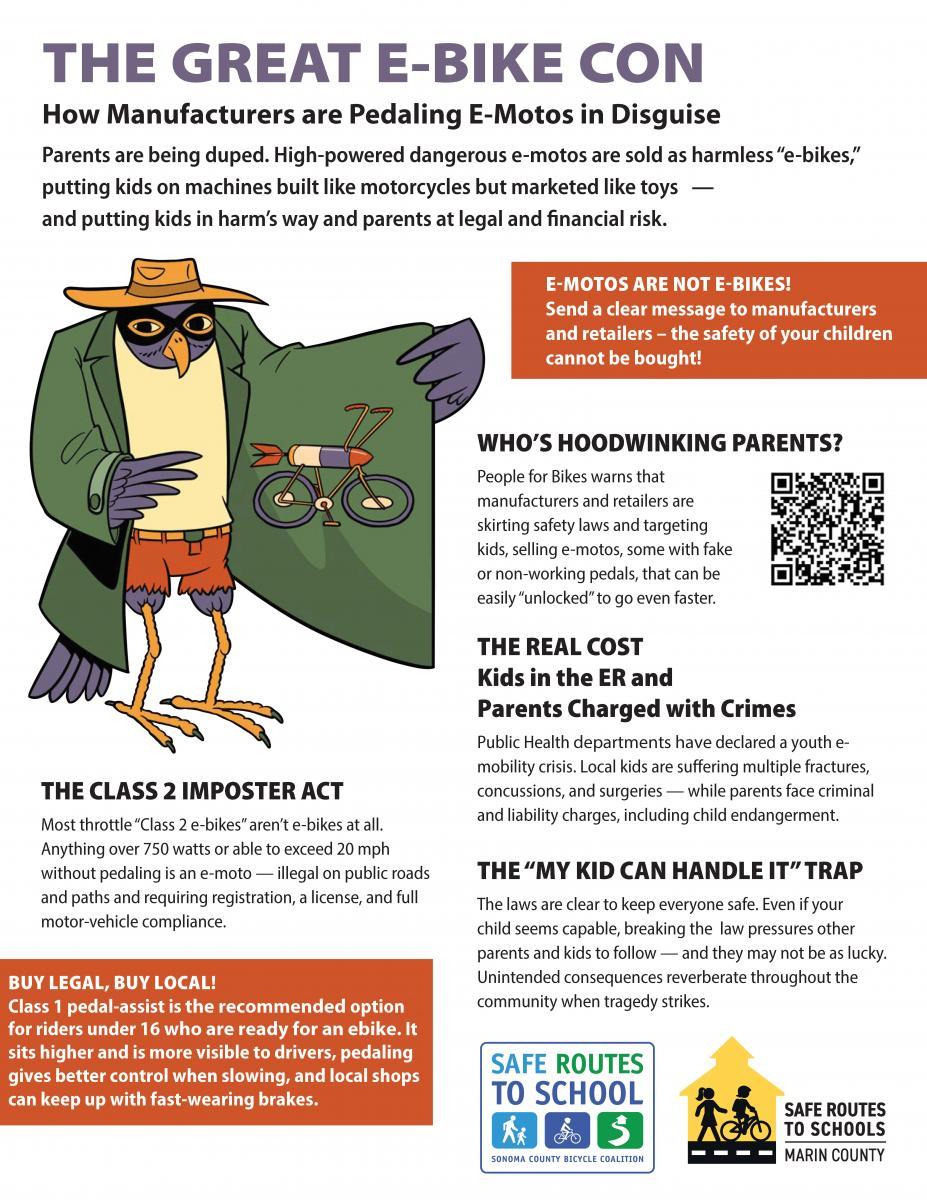
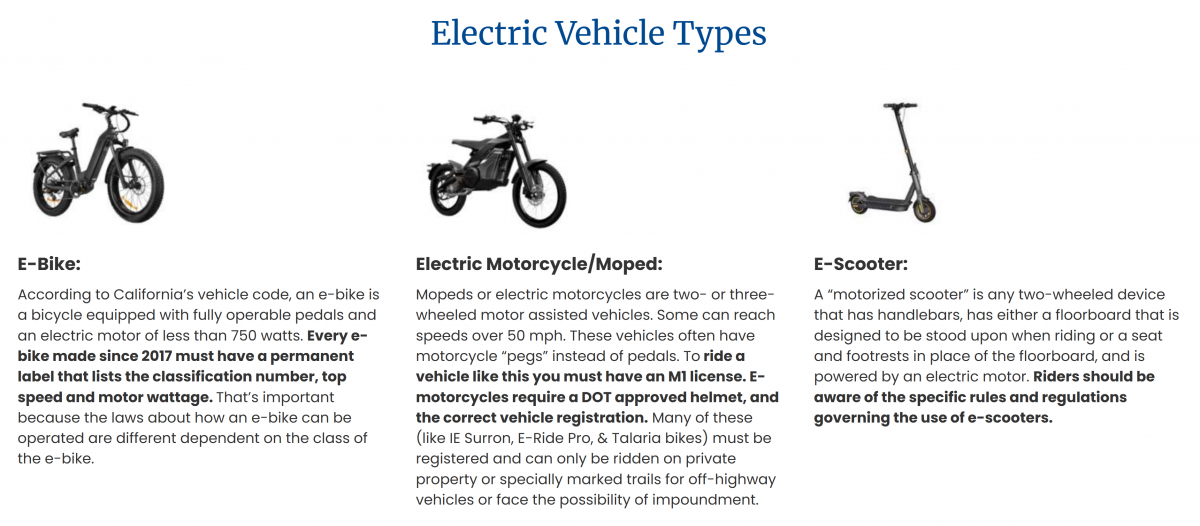
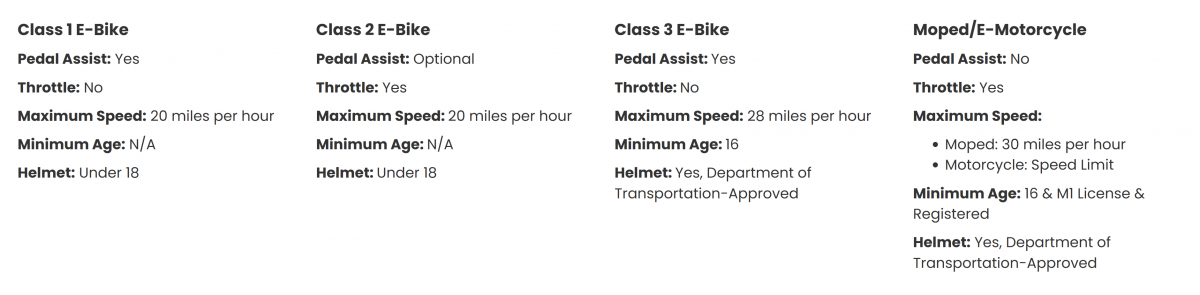
According to California Vehicle Codes and law enforcement, if a throttle device sold as a class 2 is capable of being switched into going faster than 20 mph on motor power alone, these devices are not considered low-speed electric bicycles, but resemble electric motorcycles. Note: Electric motorcycles (see electric vehicle types chart below) are not street legal.
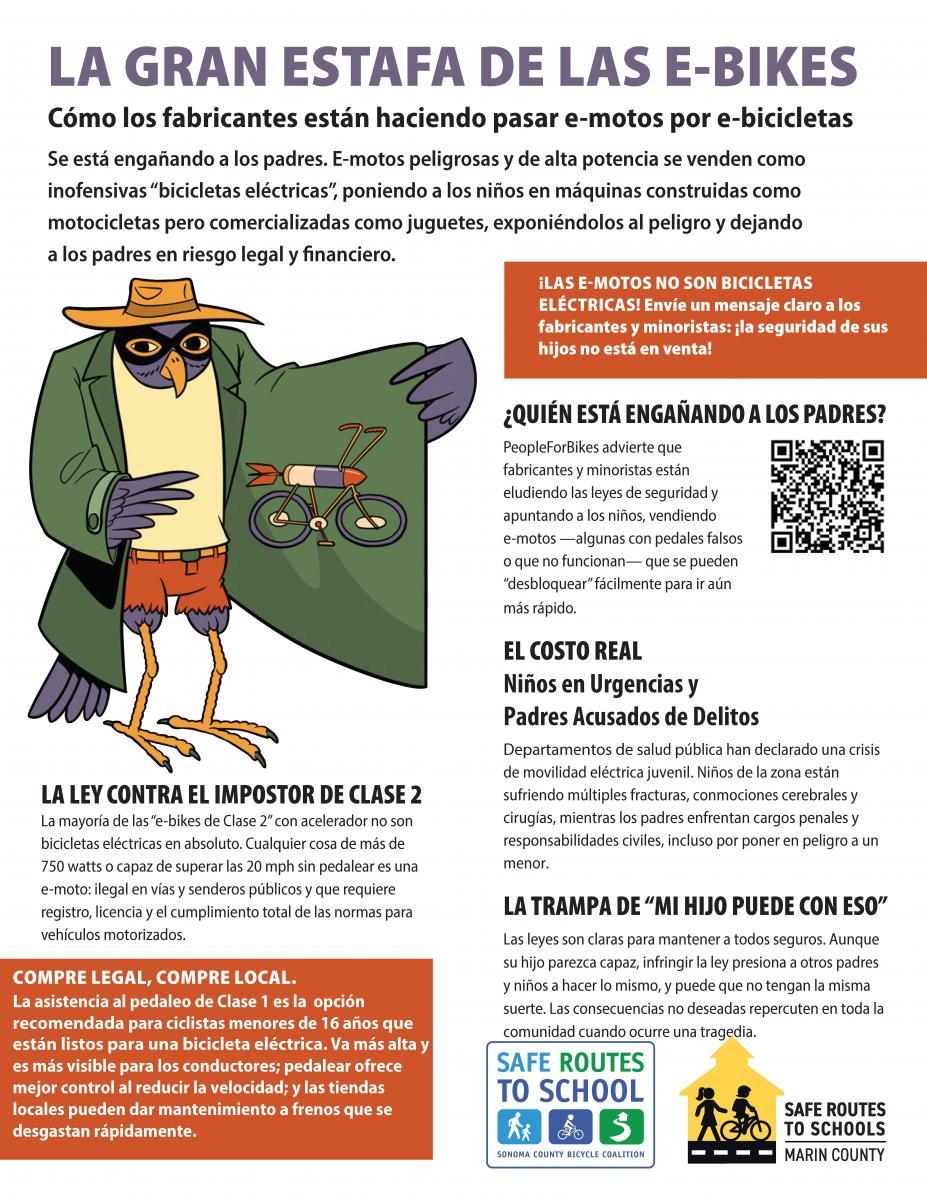
Download our "E-Bicycles: What Parents Should Know" Informational Flyer: English PDF Spanish PDF

Resources For Parents, Students, and Schools:
- E-Bike/E-Moto Safety Guide: (English PDF) (Spanish PDF) (English Pg 1 PNG) (English Pg 2 PNG) (Spanish Pg 1 PNG) (Spanish P2 PNG)
- The Great E-Bike Con flyer (English PDF) (Spanish PDF) (English JPG) (Spanish JPG)
- The E-Bike Access "Rogue E-Moto Gallery" - and how to tell if your E-Bike is really an E-Moto in disguise
- E-Bicycle Education Video Module from Sonoma County Safe Routes to School
- E-Bike Teen-Parent Agreement English MS Word Spanish MS Word English PDF Spanish PDF
- Sonoma County SRTS E-Bicycle Handbook (English) (Spanish)
- League of American Bicyclists/People for Bikes E-Bike Smart Course (free)
- Ride Ready San Diego E-Bicycle Safety online course (free)
- California Highway Patrol E-Bicycle Safety Online Course (free)
- Cycling Savvy PowerSavvy E-Bicycle Training Course ($45.00 per student)
- The Caring Parent's E-Bike Survival Guide (available for purchase) review
- E-Bicycle Safety for Youth: What Parents Should Know (Webinar, 4/1/26) Recording Slide Deck
- The Complete Guide to Electric-Scooter Safety for Kids (Market.com)
Additional Resources for School Administrators:
- Safe Routes to School E-Bike Parent Letter (Fall 2026) Elementary School Eng/Span PDF Middle/High School Eng/Span PDF
- School Action Plans: Ready to Adopt School Policy Options MS Word Version of Policy Options
- Safe Schools, Smart Policies (Policy Recommendations Flyer)
- E-bike registration application for parking on campus (template)
- Law enforcement’s letter to parents describing illegal devices (Marin County Example)
- Link to Marin County Bicycle Coalition’s Buyers Guide
- E-bike safety presentations for middle school students, high school students, or parents – contact christina@bikesonoma.org to express interest
Safety First:
The increased convenience and speed offered by e-bikes and scooters also brings the possibility of serious or life-threatening injuries. Start a conversation with your students and/or children about your expectations for smart riding, and be aware of the following safety tips:
- Know the operation and licensing requirements for the type of e-bike/scooter/motorcycle you own.
- Always wear a properly fitting, DOT-approved helmet. You’re more likely to have a crash resulting in a brain injury when you ride a faster e-bike compared to a regular bike. Make sure your helmet fits and that it’s properly adjusted and attached before you ride. Helmets designed for increased speeds are ideal.
- Slow your speed! The higher the speed, the higher the risk of severe injury. At 20 MPH, it could take you almost four school bus lengths to fully stop to avoid an obstacle. Take your time when riding and don’t exceed the manufacturer’s top speeds.
- Give yourself time to brake. E-bikes are heavier and move faster than regular bikes and therefore take longer to stop.
- Never enter an intersection without checking for oncoming traffic. Make eye contact with any drivers approaching the intersection before entering it to make sure they see you.
- Don't wear ear buds or headphones so you can remain aware of traffic and other noises around you. It's actually illegal to cover both ears while riding.
- Be aware of your surroundings and the “door zone” – the space that an open door extends beyond a vehicle parked at the curb – to avoid hitting objects or parked cars.
- Always ride with your hands on the handle-bars and your body on the seat.
- Make sure to equip bikes and scooters with reflectors and/or lights. If riding at night the law requires bike lighting.
-
Always lock your bike when storing it at a public location. Lock both wheels and the frame with a lock and always take accessories with you.
- Pro Tip: E-bikes aren’t required to be registered in CA, but there are local bike registries where you can register your e-bike by serial number and contact information to help return a lost or stolen bike to its owner.
- Watch out for blind spots, especially around buses and trucks.
- Practice passenger safety: E-bikes are heavier and harder to control with or without a passenger. Carrying a passenger is legal only if your e-bike has a seat for another person; regardless, the extra weight can make it difficult to maneuver, slow down, and stop.
-
Be Responsible, Predictable, and Visible. E-bike crashes are more likely to lead to severe injury and hospitalization compared to crashes involving regular bikes.
Be responsible: follow laws and stop at stop signs.
Be predictable: ride in the same direction as traffic.
Be visible: wear bright clothing in addition to lights.
Be E-bike and E-scooter Legal:
According to CVC 312.5 (a), legal e-bikes must have ALL THREE:
1. Working pedals
2. Maximum of 750 watts
3. Motor can NEVER, EVER EXCEED a maximum speed of 20 mph for Class 2. If the device is able to go faster than 20 mph on motor power alone, it is NOT an e-bike and is illegal for any person of any age to ride on roads and pathways.
Watch Out for Liability: Many popular Class 2 labeled brands are ILLEGAL and the operation of such puts students and their caregivers at liability risk.
- Class I and II – no age limit.
- Class III – Students must be 16 years old – NO DRIVERS LICENSE REQUIRED.
- All must wear helmets, including adults.
- E-Scooters – Students must be 16 years old – MUST HAVE A DRIVERS LICENSE OR VALID PERMIT.
- Maximum speed = 15 mph.
E-BIKE FAQ's:
Planning to purchase an e-bike for your student? Here are some additional FAQs to help you make a smart decision for your student and the community’s safety.
What kind of e-bike do you recommend that I buy for my student?
Does your student truly need an e-bike because of long distances or hills to climb? All e-bikes are harder to maneuver and take longer to stop because of the extra speed and weight, so parents should first evaluate their student’s needs and ability before purchasing one.
A Class 1 e-bike is recommended if your student already can ride a conventional bike. A Class 1 e-bike can provide assistance from its electric motor up to a speed of 20 mph, but only when the rider is pedaling. A Class 1 e-bike is still fast; it can travel twice the typical speed of a 14 year old on a regular bike (10 mph).
What’s all the hubbub about labeled “Class 2” throttle e-bikes?
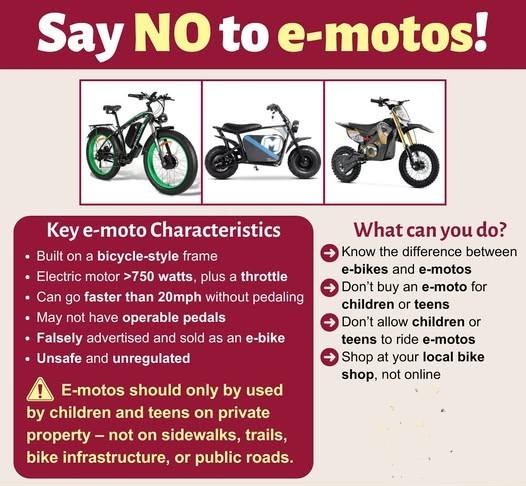
A great number of the throttle e-wheels sold in California are illegal for anyone of any age to drive because their motors are larger than 750 watts and capable of going above 20 mph without pedaling – the legal limit for a throttle e-bike. Even if they have a Class 2 e-bike label, if it is over 750 watts and capable of providing speed above 20 mph, they are e-motorcycles, and like gas motorcycles, the vehicle must be equipped with motorcycle lights and rearview mirrors, and a driver’s license and DMV registration are required. These un-equipped and unregistered e-motorcycles are not allowed to be driven by any person on public roads, streets, sidewalks or pathways.
Are people overreacting about all this?
No. Data as of October 2024 on the Marin’s Health and Human Services Bicycle Safety Dashboard reveals 85% of all 911 bicycle crashes for ages 10 to 15 were e-bike related; the e-bike crash rate for 10 to 15-year-olds is 5 times higher than any other age group. These severe injuries are similar to those involving motorcycle crashes, such as concussions (even when wearing a helmet) and broken pelvic bones with long-term or permanent consequences. Additionally, E-Bike and E-Scooter crashes have been increasing exponentially every year. 56,844 e-scooter injuries in 2022, up from 8,566 in 2017. 23,493 e-bike injuries in 2022, up from 751 in 2017.
If a throttle e-wheel has a Class 2 label, it’s legal, right?
No, unfortunately, many manufacturers of throttle e-wheels use a Class 2 label even though the bicycles they sell are capable of exceeding the legal limit of 750 watts of power and can engage the throttle when traveling over 20 mph. Software for these illegal e-wheels can be downloaded to anyone’s cellphone and used to switch the device to exceed 20 mph on motor power alone.
Why aren’t the manufacturers and sellers held accountable?
Similar to vaping, this new technology came out rapidly, leaving consumers responsible for understanding the laws and self-regulating their purchases. Marin schools and law enforcement are now attempting to enforce the laws. Lawsuits may be inevitable by consumers or injured victims to hold manufacturers and retailers accountable. California Assembly AB 1774 was signed into law. As of January 1, 2025, the state prohibits the sale of products or devices that can modify the speed of an e-bike per AB 1774.
How is it that a labeled Class 2 e-bike can go faster than 20 mph?
For e-bikes sold by certain manufacturers, the rider may use the handlebar display or an app paired with the bicycle to shift into “unlimited” mode and exceed 20 mph without pedaling. Students can use their own iPhone or a friend’s iPhone to download the app. Using the fastest “mode” for one of the most popular brands in Marin, riders can go from zero to over 30 mph (50% faster than the legal limit for Class 2 e-bikes) in 11 seconds.
My student is super responsible and obeys traffic laws. Why can’t they own one of the illegal e-wheels if they promise they will not go faster than 20 mph?
The device is illegal on public streets, roads, and pathways. In case of a crash, parents could face legal and financial liability for allowing their student to operate an illegal vehicle.
Where should I go to purchase a Class 1 e-bike or legal Class 2 e-bike for my student?
Local retailers can provide service on the e-bikes they sell. Brakes on e-bikes wear out faster than brakes on conventional bikes, so being able to service the e-bike regularly is essential to your student’s safety and the safety of others.
For more E-bike information or questions, contact saferoutes@bikesonoma.org